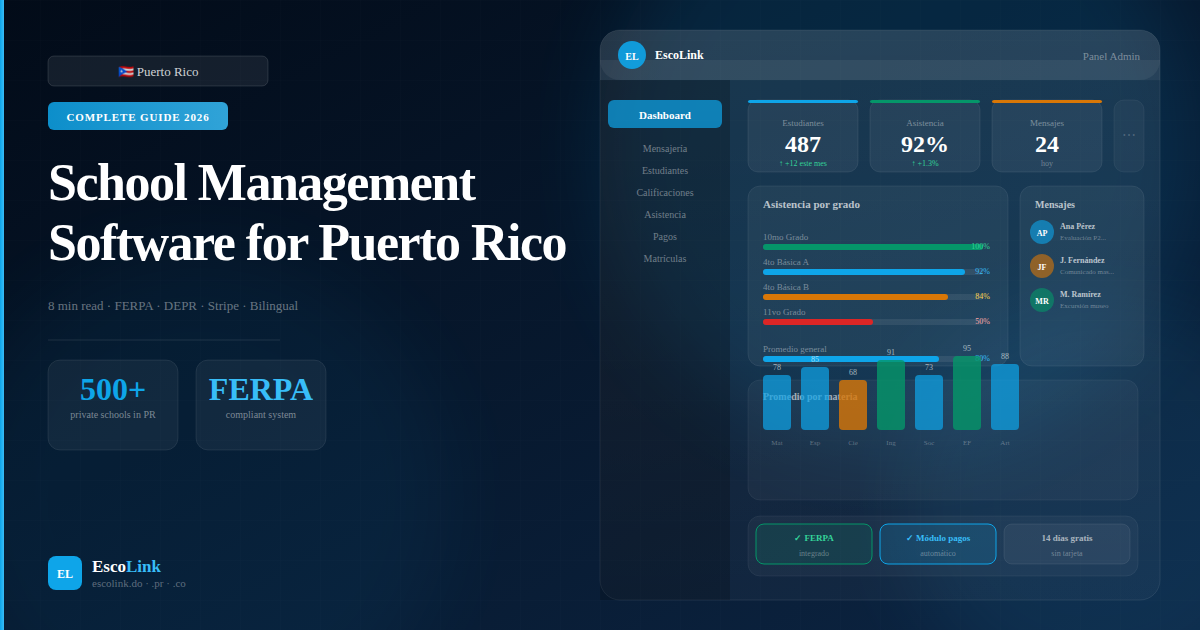
Everything Puerto Rico private school principals need to know about choosing a school management system. FERPA compliance, bilingual support, DEPR requirements, and pricing in USD.
School Management Software for Puerto Rico Private Schools: Complete Guide 2026
Puerto Rico's private education sector is experiencing a remarkable trend: for the 2025-2026 academic year, private school students represent 50% of new admissions to the University of Puerto Rico — surpassing public school students for the first time in two decades.
This growth comes with increased expectations from families. Parents who choose private education in Puerto Rico aren't just paying for a classroom — they're paying for an experience that includes professional communication, transparent reporting, and digital tools that make their lives easier.
This guide is for private school principals in Puerto Rico who want to meet those expectations while maintaining FERPA compliance and navigating DEPR requirements.
¿Listo para digitalizar tu colegio?
Agendar demo gratisThe Puerto Rico Private Education Market in 2026
Puerto Rico has approximately 400-500 active private K-12 schools, serving over 109,000 students. The concentration is highest in the metropolitan San Juan area, with significant numbers in Bayamón, Carolina, Ponce, and Caguas.
What makes Puerto Rico's private school market unique:
Federal regulations apply. As a U.S. territory, Puerto Rico private schools must comply with FERPA (Family Educational Rights and Privacy Act), COPPA (Children's Online Privacy Protection Act), and IDEA (Individuals with Disabilities Education Act) for special education programs.
Bilingual reality. Most private schools in Puerto Rico operate in Spanish, but many offer bilingual programs and some premium schools conduct instruction primarily in English. A school management system must support both languages natively.
USD pricing. Unlike Dominican Republic or Colombia, Puerto Rico operates in USD, with Stripe as the primary payment gateway for online transactions.
DEPR oversight. Private schools accredited by the Puerto Rico Department of Education (DEPR) have specific reporting requirements that differ from stateside schools.
The 5 Problems Puerto Rico Private School Principals Identify Most
1. Managing FERPA Compliance Without a System
FERPA gives parents the right to access their child's educational records and restricts disclosure of student information to third parties. Without a proper system, compliance becomes a manual, error-prone process.
Common FERPA violations in schools without systems:
- Student information shared via unsecured email or WhatsApp
- No audit trail of who accessed student records
- Unclear consent documentation for photo/video release
- Directory information disclosure without proper opt-out management
A FERPA-compliant school management system maintains an audit log of all record access, manages consent digitally, and restricts information sharing based on user roles.
2. The WhatsApp Problem
Puerto Rico private school teachers are deeply embedded in parent WhatsApp groups — and it creates the same problems as in the Dominican Republic: teacher burnout from 24/7 availability, lost message history, mixing personal and professional communication, and no official record of communications.
One principal from San Juan shared: "I had a teacher receive a message at 11pm asking about a grade. She felt obligated to respond. That's not sustainable."
3. Bilingual Reporting Challenges
Many Puerto Rico private schools need to generate reports in both Spanish and English — for local DEPR requirements (Spanish) and for federal compliance documentation (English). Managing this manually means creating duplicate documents.
4. Special Education Documentation
Puerto Rico has a significant percentage of students with Individualized Education Programs (IEPs). Private schools that accept special education students (and receive Title I or IDEA funds) need to maintain documentation that meets federal standards.
5. The Form 480.7E Generation in January
Puerto Rico's Hacienda requires schools to issue Form 480.7E to parents every January — a certification of educational expenses paid during the previous year that parents use for their income tax filing. Generating this manually for every family is a multi-day process.
FERPA Compliance: What Your Software Must Do
Any school management software used in Puerto Rico must meet these FERPA requirements:
Access Controls
- Role-based access: not every staff member should see every record
- Parents can only access their own child's information
- Divorced/separated parent situations require specific custody-based access controls
Audit Trail
- Every access to student records must be logged
- Who viewed what, when, from what IP address
- Exportable for FERPA compliance audits
Consent Management
- Digital records of parental consent for:
- Photo/video release
- School website publication
- Third-party disclosure
- Marketing materials
- Easy opt-out management when parents revoke consent
Data Security
- Encrypted storage of student records
- Secure transmission (HTTPS)
- Data retention policies compliant with FERPA's minimum 7-year requirement
Bilingual Support: More Than Just Translating Buttons
True bilingual support in a school management system means:
- Per-user language preference: a teacher who prefers English can use the system in English while a parent prefers Spanish
- Bilingual notifications: the same attendance alert can go to parents in their preferred language
- Bilingual report generation: the same grade report can be generated in Spanish (for DEPR) or English (for accreditation bodies)
- Spanish-specific terminology: in Puerto Rico, the terminology follows the local educational system, not a direct translation of U.S. school terminology
EscoLink was built with Puerto Rico's bilingual reality in mind. Spanish (es-PR) and English (en-US) are both fully supported, with the ability to set language preferences per user.
DEPR Requirements: What You Need to Report
Private schools accredited by DEPR must maintain and be able to report:
- Annual enrollment statistics by grade, gender, and disability status
- Teacher certification status
- Attendance records (available for inspection upon request)
- Academic performance data for accreditation renewal
A good school management system should be able to generate these reports with a few clicks, without manual data compilation.
Pricing in Puerto Rico: What to Expect
Puerto Rico private schools operate in USD, which means pricing is typically more aligned with U.S. mainland software than Latin American pricing.
However, most U.S.-based school management software is designed for large districts of 5,000+ students. Puerto Rico's private schools are typically 100-800 students — a very different scale with very different needs (and budget).
EscoLink offers Puerto Rico pricing starting at:
- Starter: $29/month (up to 200 students)
- Pro: $79/month (up to 1,000 students)
- Enterprise: Custom pricing
For a school with 350 students, $79/month represents approximately what a part-time administrative assistant earns in 2-3 hours. The time savings from automation typically exceed 80 hours per month.
Questions Puerto Rico Principals Ask Most
Is it truly FERPA compliant? EscoLink maintains full audit logs, role-based access controls, consent management, and encrypted data storage that meets FERPA requirements. For schools with federal funding, we recommend consulting with your Title I coordinator regarding specific reporting requirements.
Can it handle our bilingual curriculum? Yes. The system supports both Spanish and English at the user level — teachers can use English, parents can use Spanish, and reports can be generated in either language.
Does it generate Form 480.7E for Hacienda? Yes. In January, the system automatically generates the 480.7E certification for every family, showing the total paid during the previous calendar year.
Does it work for special education documentation? EscoLink includes basic IEP documentation and accommodation tracking. For schools with complex special education programs, we can discuss enterprise-level customization.
Can parents pay online? Yes, via Stripe. Parents can pay tuition and fees online with any U.S. credit or debit card. The system generates a receipt automatically.
Conclusion
Puerto Rico's private school sector is growing — but with growth comes higher expectations from families and more complex compliance requirements. A school management system that handles FERPA compliance, bilingual communication, DEPR reporting, and Form 480.7E generation isn't a luxury; it's the foundation of a professionally run institution.
Schedule a demo specifically designed for Puerto Rico private schools, and we'll show you exactly how EscoLink handles the unique requirements of the Puerto Rico educational market — in both English and Spanish.